Wednesday, June 11, 2014

Sissinghurst

Sissinghurst, once the home of Vita Sackville-West and Harold Nicolson, is now part of the National Trust.  Sackville-West deserves several entries on her own, but I admit I never studied her work except peripherally and know only a little about her life.  Of Nicolson I know even less.  Since this trip was about the gardens, I'll stick with that topic.  

This gardens at Sissinghurst ("themed garden rooms, wildlife gardens") will take two days to cover.  I really tried to pare down my choices of photographs, but there was so much to see that I found it impossible to get the collection to a manageable size for one day.  Fasten your seat belts for the ride:


This is the entrance to the house, the main part of the estate, and the gardens.  I had to walk quite a way away from the entrance to be able to take a picture of the entire building at one time.   Behind it you can see the tower.

Here is the Elizabethan Tower.  The winding staircase we climbed is on the  left side, and you go around and around (hoping you don't meet anyone coming down which, of course, one does) past windows full of colored glassware - one cobalt blue, the other gloriously red.  There are also rooms in one of which Vita Sackville-West did her writing.  Once at the top, one seems to pop out like a jack-in-the-box onto a surprisingly large area.  Surprising because the tight quarters in the staircase make one forget the size of the entire structure.  The walls around this upper viewing area are tall enough so one feels comfortable while still able to enjoy spectacular views of the garden "rooms" and the surrounding countryside.  I just loved it!


In this view, you can see the beautifully manicured hedge that defines this particular room.  Again, hedges are something the English do very well; they (the wealthier, of course) have the land, the time, and the help to plant, nurture, and maintain intricate hedges of many different sizes and shapes.  Naturally, I had read about English hedges all my life, but I never really appreciated them until this trip.


This view is of an area outside the walled garden rooms though still of the estate.  It gives you an view of the English countryside.  One of the things that D noticed especially is that in England (or at least in the southeastern portion), one doesn't see uncultivated land.  Here, we drive down a road and pass houses and then there are woods or fields that are uncultivated.  What you see here in the distance in this photograph is what we saw every day from the bus windows.  There would be small villages and then tended fields as far as the eye could see broken only by lines of trees or stone walls.


As you can tell, I like corners of the gardens that aren't intended to be a focal point but are anyway.


Remember what I said about hedges and how the English do them very well?  Isn't this amazing?  Along the pathway, there are openings in the hedges that will take you off into a room or a path to another area.  If you watched from the tower, you would see people disappearing into these hedges from time to time, and you wouldn't always be sure where they came out again.  Our horticultural expert simply would say that we would be "diving through the hedge again" to alert us that she was disappearing and we were to follow her Alice act with blind faith and fall into an invisible opening in the hedge.


Sissinghurst has serious oust houses!


Lovely view of the tower.

All right.  You've been patient with me.  Here are some garden pictures for you!  Everywhere we went on this trip one would see huge rose bushes climbing up buildings, walls, trees, what ever they could find to support them.  On the right is a combination of old rose and allium for which I developed a passion.  They will be in my garden next year for sure!


And finally, verbascum.  Another flower I've overlooked before this trip, but which I have added to my short list of  "must have".

More of Sissinghurst's gardens tomorrow.


Tuesday, June 10, 2014

From Dover to Great Dixter

The first time I went to England, I crossed the Channel from Calais to Folkstone in bad weather and never got a good look at the White Cliffs of Dover.  We took care of that during this trip:


You have to use your imagination a little to get past the evidence of modern life in this photos, but at least you can see that the cliffs are really white.  On a sunny day looking toward land from the sea, they must be quite a sight indeed.  We stopped very briefly in Dover after visiting Goodnestone (written about in yesterday's blog) before going on to our hotel.

The next day we went to visit Great Dixter by way of the Cinque Port of Rye, a medieval town where we had lunch.  This was our rainiest day, and we didn't have enough time to manage sight-seeing and lunch so it has wound up being our least successful part of the trip.  


Yet I managed to "collect" another lovely tree; this is a laburnum aka "Golden Rain" tree.  They are quite special and one sees them all over the sourtheast of England.


The Norman castle which we did not visit due to our desire to see more in the short time we had.


In the church which boasts an unusual clock with a 16 foot pendulum.  It also had on display this quilt triptych complete with stones.


After that hurried visit, we drove on to Great Dixter to see an Edwardian style garden (formal design with informal perennial plantings).  Remember it was a rainy day, darker than our other days, so the pictures will also be dark.


This is the older part of the home to which was added the portion in the photo below.


The addition was very well done; the roof lines and materials are the same, the windows and chimneys also, and the colors are harmonious.  Inside, this manor is very warm and inviting - a family place despite its size.


English oast houses (where the hops are dried) are architecturally different from ours.  The oddly shaped tops turn to catch the wind which helps in the drying process.


I didn't do a very good job of taking photos of the "formal beds with informal perennial plantings", but I took pictures of things that caught my eye.  The steps above have plants happily growing in among the stones.


As does the wall beside those steps.  This informality in the gardens is something I really liked and found charming.


Can't pass up waterlilies.


Lovely even on a gray day!


One of my favorite corners of the garden.  The stones used in the base of the chimney are limestone which you find as building material all over the southeast of England.  Depending on where it is quarried, it has a different color - from gray to cream to yellow - and it's all gorgeous.


Monday, June 9, 2014

Canterbury and Goodnestone

Another day with photos, but for those of you who have asked, today you will see the first garden we visited (not counting Kensington which was an informal visit).

First let me explain that I adored Chaucer and relished reading the Canterbury Tales. Learning about the development of our language, the standardization of spelling, the pronunciation of Middle English - all these things were a delight for me, and the stories?  Oh my, what's not to like about the stories Chaucer told?  Now, having admitted to all that, I will tell you to relax because you won't be subjected to any of it.  We didn't tour the Cathedral or the Canterbury Tales Museum.  D wanted to see the restoration of the Roman building that had been unearthed in Canterbury so that's what we did, and it was interesting - especially one part of which I took a number of pictures (quilting friends, think fabric!).


This is the town library.


I did get to see some of the cathedral!


Quilters, here's my favorite part of the Roman building!


 Aren't these fabrics grand?


Part of the old castle.  I loved the way flowers grew wherever they darn well pleased!


This is part of the original wall - like many ancient cities, Canterbury was fortified.  The wall is made of chert, a type of flint.


Here is a close up of the chert wall; it's really quite pretty.  Note the flower!

Now, on to Goodnestone (pronounced Gunstun) where Jane Austen is supposed to have begun writing Pride and Prejudice) and photos from the gardens there.


 One of the things I noticed everywhere we went and I hope to introduce in our gardens, is the attention given to the colors in foliage as well as size and texture.  In short, it's not all about flowers in great gardens.


This was the first Cedar of Lebanon tree I saw and learned what it was.  The seed was brought to England by plant hunters in the 17th century, and by the 18th century the great estates all had one.


Portrait of a rose.

View from the garden.


And another view - this reminds me of photos in magazines that I always found difficult to believe!


Roof top showing a proliferation of chimneys.


 More flower portraits - this is Astrantia,


 a single peony,


 more peonies,


 Chinese wisteria,


 and a tree in the Golden Arbor (planted by the current owner for her husband on their 50th anniversary).


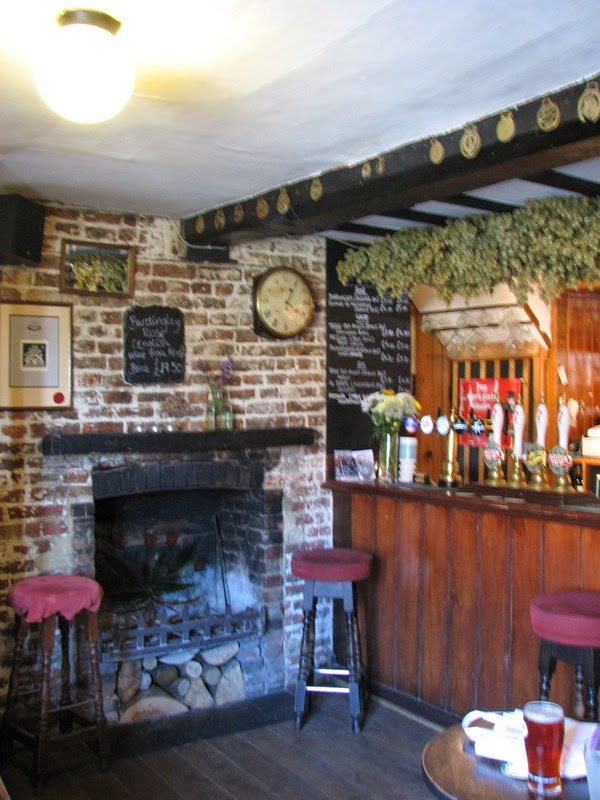
 This is the village pub which, of course, we had to visit!  That's D's beer on the table.

 Windows in the pub.


And finally, the village church.

Sunday, June 8, 2014

London

It has been far too long, but I am back.  However, I should warn you that I will be talking about our trip to England and showing photographs from that trip for some time.  First the minor details.  This was our fifth  trip taken through Road Scholar, an organization that has existed for some time now, and is committed to "life-long learning". 

When we were young we each traveled to England on separate occasions before we married and then went there together on our wedding trip.  So it had been quite a while since either of us had been in England so it was with a great deal of excitement that we embarked on this adventure.  By the way, we shared this excursion with one of my brothers and his wife, the same couple whose company we enjoy so much in the summer at the lake.

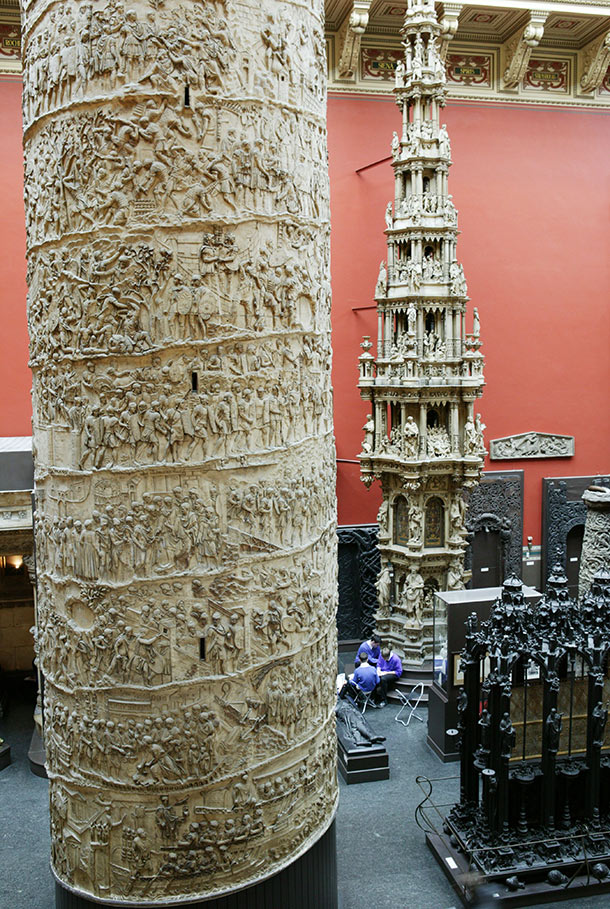
The first stop was London; due to a camera mishap, the earliest photos taken specifically for painting purposes were lost, but the sightseeing kind were still on the memory card.  Our first foray was to the Victoria and Albert Museum which is huge so we limited ourselves to a few exhibits.  One that really knocked my socks off was the Cast Courts.  During the Victorian era copies were made of both works of art and architecture so people who couldn't or just didn't travel could see some of the world's wonders.  I knew about art castings but had no knowledge of the architectural side or its scale of this activity.  Below, if it does remain in this blog, is a photo from the V&A Museum (with the its address so you can find it and other photos) that shows Trajan's column with two people near its base.  My photos do not have people in them which makes it difficult to appreciate the sheer size of some of these castings.
Plaster cast reproduction of Trajan's Column by Monsieur Oudry, Paris, about 1864. Museum no. REPRO.1864-128, © Victoria and Albert Museum, London
http://www.vam.ac.uk/content/articles/t/the-vanda-cast-collection/

Here are a few photos (remember to click on the image to bring up a slide show that shows the photos in larger scale) I took from the Korean exhibit: 


 the Cast Collection:

and wood work from the outside of a building built during the medieval age.


The remaining photographs are all from Kensington Gardens:


A white rose.


Centifolia roses,


Herbaceous borders,


Flowering trees,


a conversation with "foreign" wildlife,


and the Albert Memorial.

That's probably more than enough for one day!  Tomorrow we'll move out of London.