Sunday, July 6, 2014

Blenheim #2

The last photo in last Thursday's entry showed the lake from the walkway.  That walk led eventually to a waterfall; for after all, what would a lake be without a waterfall?


And on the bridge people looking in several different directions,


and tourists just posing.


A covey of Chinese ringneck pheasants just happened to stroll by.  Or at least the cock did.


Doesn't this remind you of Monet's bridge at Giverny paintings?  Even though this is not an Oriental-style bridge (the one closer to the waterfall is), the colors and the general composition remind of an Impressionist painting.  Hmmm . . .


Blenheim Palace seen from below.


Waterlily trapped by leaves.


Courting grebes.


A lovely white rose.


Okay, here I go off track again ("Look, there's a chicken!" or in the case of the following four photographs, "Look, there's a window!").  These were taken from inside the Palace looking out.


I love the way the old window panes "warped" the view from the angle at which I took this picture.


Same window and view but a not-as-sideways angle changed the picture quite a bit.


Different room, clean spare view of rose and clouds.


Close-up of said rose.  Everyone else was finishing lunch or sitting chatting while I wandered.


A few pictures of the decorations in one of the state rooms where guests assembled.  Here is part of one wall . . . 


And the painting on the ceiling. 


Here in a tiny chapel is the memorial to the first Duke of Marlborough.


Just in case one wasn't sure what one was seeing, here is the inscription.  


After lunch, we took a walk back to a place we especially liked, the Secret Garden.  It took us a while to find it again as it was well hidden (!).  I wonder if the figure in the above photo was trying to find it, also?


A koi pond (for you ME) in the Secret Garden.


Another photo taken to remind me of color, size, and texture.

And that's the end of the photo journal of our trip to see the "Great Gardens of England".  Now what'll I write about?

Thursday, July 3, 2014

Blenheim #1

Already I can tell that Blenheim will take more than one day.  Possibly more than two if the number of photos I've earmarked is any indication.  I'll just dive right in:


There are several portals through which one passes in order to get to the entrance of the Palace proper.  This is the outer gate.


D's ticket to enter.


This is the second portal.


The is the inner courtyard, and all those people are walking up the steps to the main entrance to the palace.


Wouldn't you know this would be one of the only really sunny days during our trip.  Here is the group of us all squinting into the sun as a group photo is taken - taken with each person's camera.  You can imagine what the last photos must look like - eyes closed and tears streaming down faces!


Blenheim's gardens represent the peak of the Landscape Style and also Edwardian (formal design with informal perennial plantings).  Water features are an important element. There is a reason for the odd-to-us color of the water.  If I remember correctly it makes reflections easier to see than black or dark green water. 

Another constructed water feature is the lake.  Originally there wasn't one there so Capability Brown (garden designer) constructed one.  Lots and lots of packed mud and clay were carted in and pressed into place to form the lake bed.  It took years to build and care must be taken to keep it from leaking which it does periodically.


A beautiful fountain surrounded by smaller ones and parterre de broderie.  My quilting friends will probably pick up the meaning of that phrase because we use the phrase broderie perse, a type of applique.  For those of you for whom this is a new term, I found a good definition in the on-line Brittanica and have included it for you.  While very formal, I found it quite lovely although daunting to replicate!

broderie, also called parterre de broderie (French: “parterre of embroidery”),  type of parterre garden evolved in France in the late 16th century by Étienne Dupérac and characterized by the division of paths and beds to form an embroidery-like pattern. The patterns were flowing ribbons of form (generally of formalized foliate design) rather than the angular shapes typical of other types of parterre; and the various beds into which the parterre was divided by paths were coordinated in a single symmetrical design.*


And then there are the topiary birds.


Several times I found myself astonished by the vast expanses.  The size of the trees give you a sense of how big this estate is to be able to have many, many trees of amazing girth and height.


And speaking of vast expanses; I wasn't able to get the entire Palace in this photo.


Now back to some gardens.  When I started these entries on our trip, I mentioned what I learned and listed color, texture, and size.  This photo shows all three characteristics in foliage (it was impressed upon me that foliage plays a pivotal role in the success of a garden).


Here again- look at all the different shapes, colors, and sizes.  Of course, there's water, too (unexpected, I know).


Those quick glimpses one gets while on the way to somewhere else.


A view of the lake through the trees.


Walking beside the lake, no matter where one looks, it's a painting waiting to be started.


Look at the surface of the water - reflections, yes, but texture, also - even without a ripple!

More of the lake and beyond next time.

*http://www.britannica.com/EBchecked/topic/80672/broderie

Wednesday, July 2, 2014

Stourhead Garden #2 and Alexander Pope

Alexander Pope is not one of my favorite poets, in part, I suppose because I never had reason to study more than the occasional poem.   I didn't read enough of his work to get a true sense of what he had to say.  Our visit to Stourhead Garden introduced me to a piece of his writing with which I was unfamiliar; it was on a wooden sign:


I didn't "get" it, and I found myself puzzling over these two lines.  If I didn't understand it and didn't have the necessary background to be able to understand it, how many other visitors were equally flummoxed?  I was reminded of that frustration as I went through these photographs so I did some research.  Voila, I found it and light dawned:
Consult the genius of the place in all;
That tells the waters or to rise, or fall;
Or helps th' ambitious hill the heav'ns to scale,
Or scoops in circling theatres the vale;
Calls in the country, catches opening glades,
Joins willing woods, and varies shades from shades,
Now breaks, or now directs, th' intending lines;
Paints as you plant, and, as you work, designs.
           from  Epistle IV, to Richard Boyle, Earl of Burlington

Pope's verse laid the foundation for one of the most widely agreed principles of landscape architecture. This is the principle that landscape designs should always be adapted to the context in which they are located.*  (The italics are mine)
Generally speaking, I am wary of what I find in Wikipedia, but this time it made sense so I accepted it.  If you don't agree or have a different interpretation, please let me know!  And also, the problem our horticultural expert had with the American metasequoia being too large for its setting (see yesterday's entry) makes more sense to me after reading this landscape designs (or read "landscape materials", i.e., trees) should always be adapted to the context in which they are located.
Okay, enough of all that.  Here are the rest of the photographs from this garden.  Toward the end there are pictures taken after we left the garden and wandered a little afield.

The wooden plaque with the Pope quotation was right here looking over the lake.


I really like this one because of the people and how they are reacting to the landscape.  Click on it to see what they are doing.


What a tree trunk - magnificent!


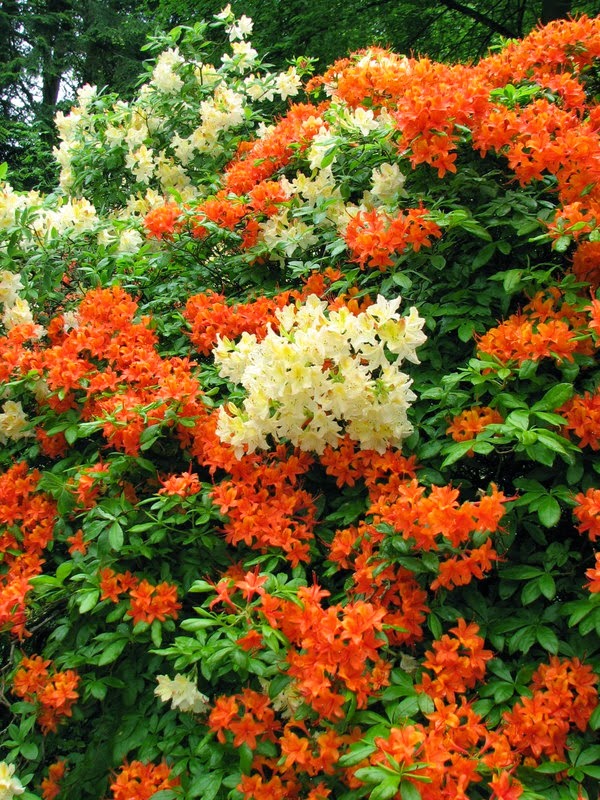
And the rhododendrons


And a magnolia.


Wonderful church (it would be so easy to collect churches, wouldn't it? such history and such beauty).


Here is a doorway and windows!


Couldn't resist (after asking her mum if it was okay to take this picture) this little cherub was walking her dog through this beginning bower.  Her mum said they come every day the weather is good, and the little one walks through the tunnel every day.  Did you notice her hair is the same color as her dog (Cavalier King Charles spaniel, I think, right SMcG?)


We started to walk off down the road to find a pub until a local warned us against it.  There are no sidewalks, no room to avoid careening autos, and as she said, they do careen!


Again - wonderful doorway and wonderful stone to say nothing of the hanging plants.


No sidewalks, but there was a phone box in the middle of seeming nowhere!

Our last garden tomorrow at Blenheim Palace, the seat of the Duke of Marlborough.

*  http://en.wikipedia.org/wiki/Genius_loci

Tuesday, July 1, 2014

Stourhead Garden #1

We returned from D.C. Sunday afternoon, and I just finished the last load of laundry (as well as all the other accumulated tasks).  Now I am ready to return to England and finish the record of that trip - I hope by the end of this week.

Stourhead is out of order as we visited that garden the same day as we went to Bath, May 29th.  Stourhead Garden is part of the National Trust and is an example of early (1730-40's ) Landscape Style that was refined and made very popular by Capability Brown (his name wasn't really "Capability", it was "Lancelot") in the 18th century.  In other words, this style of garden focused more on the vast sweep of beautiful landscape with trees and water, shrubs and lovely buildings in which one could sit and view it all.  I will warn you now that some of these photos of mine will remind you of either a calendar or the work of Thomas Kincaid (and I'd prefer the former!).  Take time to check out the reflections in the photographs - to say nothing of the colors, and you'll see what I mean.


Stourhead Garden has a wonderful collection of rhododendron which flourish in England's climate.  Many are tree-tall.


This is a Monkey Puzzle Tree in the middle of this picture.  It looks like a tree having a "bad hair" day.  It's a native of Chile, grows very tall, and bears its branches at the top.


You can see the Temple of Flora in both the above and the below photos.  Oh, and the another one down a bit farther.  Guess I liked the temple.


Another thing Landscape Style gardens may have is a grotto.  Here is a view of the bridge from the grotto in this garden.


Those rhododendrons are quite spectacular, don't you think?


This is another little building (a thatched cottage in this case) covered with beautiful honeysuckle. Both the windows and the stone bench in front of them have a wonderful view of the lake.


While our horticultural expert talked about the "plant hunters" and where they went to find the specimens they brought back to the wealthy for their gardens, she also pointed out that some plants they brought back really weren't best suited for their new homes.  In this case you can see some tall evergreens, probably metasequoia from the U.S., that are towering above the trees native to England.  They don't fit as they are too tall (more apparent in the reflection).


More pictures of Stourhead Gardens tomorrow.